
When your customer asks for your security evidence.
If your customer is using Vittnor — Supply Chain Assurance for the mid-market — to assess you, you'll receive questionnaires from them via the platform. This page explains what to expect, how to navigate it, and how to make next year's assessment easier than this year's.
Microsoft Azure, EU regions only.
Read the long-formFull list, updated on every change. DPA template available before the deal.
Read the long-formHash-anchored, signed, decision-traced. Stands up six months later, unchanged.
Read the long-formYour customer is preparing for NIS2 — and you're in their supply chain.
Most likely your customer is preparing for NIS2 compliance, or another framework like DORA, ISO 27001 supplier provisions, or their own internal risk programme. They need documented evidence of how their suppliers — including you — manage cybersecurity.
Article 21(2)(d) of NIS2 specifically requires regulated entities to assess the cybersecurity posture of their suppliers and document the evidence behind those decisions. This isn't bureaucracy for its own sake — it's a real shift in how supply chain assurance works in the EU, and it's affecting every supplier of every regulated business.
A clear list of what's being asked — and when it's due.
- Evidence items your customer has requested (e.g. ISO 27001 certificate, sub-processor list, privileged-access policy)
- Clear deadlines for each item
- Upload directly, or link a URL where the evidence already lives
- A note field for context the reviewer should know
- Save as draft — your progress is kept if you get interrupted
You see only what's been requested of you. You don't see other suppliers' submissions.
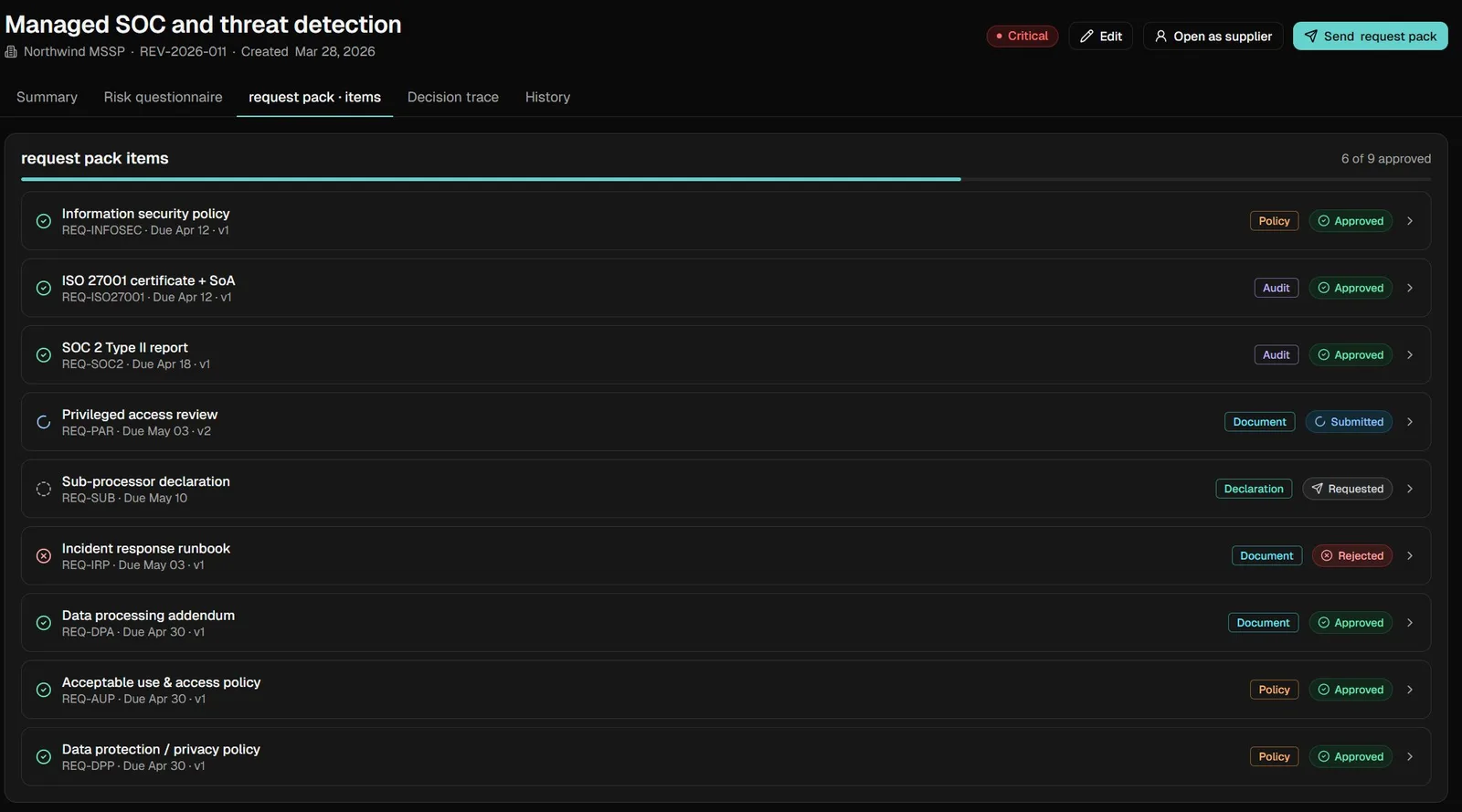
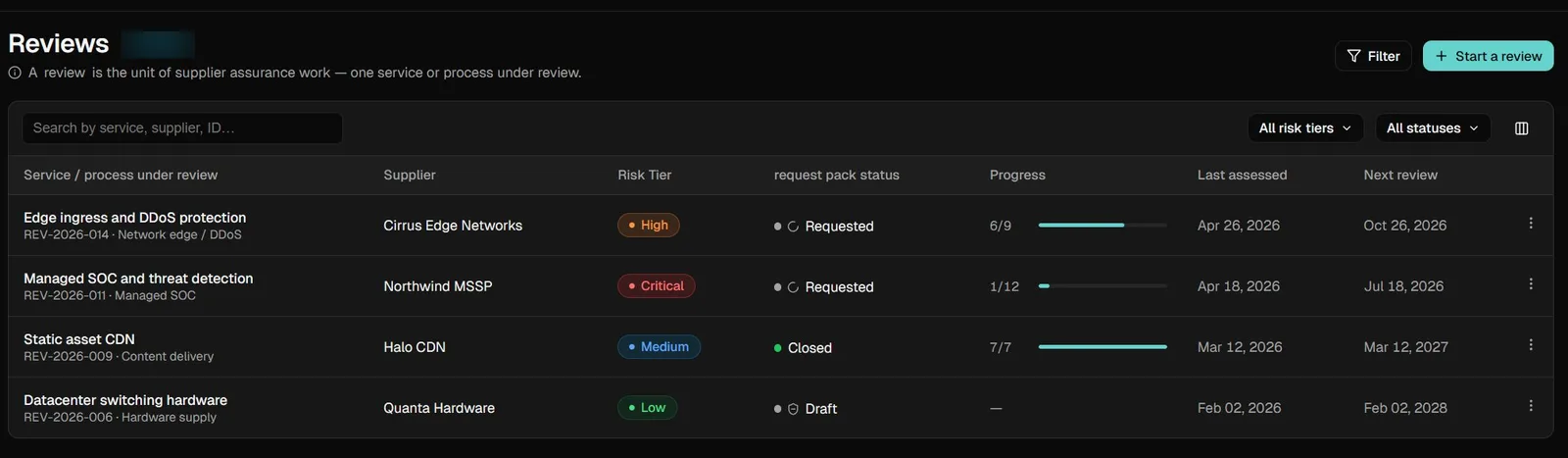
Your submission. Their review. Both sides in sync.
Your customer's reviewers see only your submission — not anything you've sent to other customers. They work through the evidence you've uploaded, mark items approved or send them back for clarification, and you see every update in your dashboard.
No more chasing email threads. No more wondering if your documents arrived. The review is tracked, both sides see the same status, and you get notified when something needs attention.
It gets easier every time.
Build it once, keep it organised.
When you upload evidence to a customer request, the platform keeps every artefact you have uploaded in one library — current version, expiry date, and the requests it answered. The next request starts from what you already proved. Cross-customer reuse is planned for later versions.
Predictable review loop.
You see when your customer reviewed each item, what they approved, and what they sent back for clarification. No more "did they get my email?" loops.
Build a posture portfolio.
Over time, your evidence library becomes a durable asset — useful for repeat requests, audit prep, and your own internal review. The same artefact, organised once — ready the next time anyone asks.
Your customer invites you. You click through.
You'll receive an email invitation from your customer. Click through, set up your account, and their request will be waiting for you. Suppliers aren't onboarded proactively — your customer initiates the relationship.
If you're expecting requests but haven't received an invitation, ask your customer's compliance contact to invite you, or get in touch directly.
Get in touchCommon questions
Do I have to pay to use this?+
No. Suppliers don't pay anything. Your customer is the one running the platform; you receive customer requests, upload evidence, and respond. There's no charge to suppliers.
What if I don't have a SOC 2 or ISO 27001 certificate?+
That's normal. Most mid-market suppliers don't, and the platform is designed for that. Your customer's questionnaire will be tailored to your size and the criticality of what you provide — for many suppliers it's policies, sub-processor lists, and incident-response contacts, not formal certifications.
Does my customer see what I sent to other customers?+
No. Each customer sees only your submission to them. Your evidence library is private to you — your customer reviews what you attach to their request, and nothing you have sent elsewhere is exposed.
Where is my data stored?+
Microsoft Azure, EU regions only. The platform is EU-built and EU-hosted; no evidence leaves the EU without explicit configuration. Sub-processor list is published and updated on every change.
Who owns the evidence I upload?+
You do. Evidence stays under your control — your customer reviews it, but they do not take ownership of it. If you ever stop using the platform, you can export everything in machine-readable format.
How long does responding to a customer request take?+
Depends on what your customer asks for. A typical first request — policies, sub-processor list, incident contacts, a privileged-access summary — runs about 2–4 hours of effort if your evidence is to hand. Each new request starts from the library you already built — cross-customer reuse is planned for later versions.
What if I disagree with my customer's decision on an evidence item?+
You can respond directly in the platform — every item has a context note field, and your customer's reviewer sees the back-and-forth. The decision and its rationale are timestamped on both sides, so disagreements are surfaced rather than lost in email.
Is this required for me to keep my customer's business?+
It is not legally required of you specifically — NIS2 puts the obligation on your customer, who then assesses you. But if your customer is regulated, expect the assurance request volume to keep growing. The platform exists to make answering them faster — each new request starts from the evidence library you already built, rather than from scratch.
You sit on both sides of NIS2.
Regulated yourself under Annex I, supplier-side to every regulated customer you serve, and a co-delivery channel for the Assessment — the full MSP / MSSP picture lives on the partners page, including the channel economics and the honest scope of the supplier surface at pilot stage.
See the MSP / MSSP partner pageMany buyers started as suppliers.
If you also run your own supplier-assurance programme — managing the risk in your own supply chain — the same platform serves the buyer side too. The companies that answer assessments today are often the ones sending them tomorrow.